How Do I Do the Arts and Culture Selfie Thing
When Google Arts & Civilization's new selfie-matching feature went viral earlier this calendar week, many people of color constitute that their results were limited or skewed toward subservient and exoticized figures. In other words, information technology pretty much captured the experience of exploring most American or European art museums as a minority.
The app was launched in 2016 past Google'southward Cultural Found, but the art selfies made information technology go viral for the start time. The characteristic is currently available only in parts of the United States (a spokesperson said Google has "no further plans to announce at this time" for other locations), but information technology nevertheless managed to have Google Arts & Civilization to the top of the most-downloaded free apps for iOS and Android this calendar week.
The selfie feature shows how engineering can make fine art more engaging, simply it is also a reminder of fine art'due south historic biases. It underscores the fact that the art world, like the tech industry, however suffers from a critical lack of variety, which it must fix in guild to ensure its hereafter.

Matches uploaded past Instagram users
Many people of color discovered that their results seemed to draw from relatively limited pool of artwork, as Digg News editor Benjamin Goggin noted. Others got matches filled with the stereotypical tropes that white artists often resorted to when depicting people of color: slaves, servants or, in the case of many women, sexualized novelties. A Google spokesperson told TechCrunch that the visitor is "limited by the images we accept on our platform. Historical artworks ofttimes don't reflect the diversity of the world. We are working difficult to bring more various artworks online."
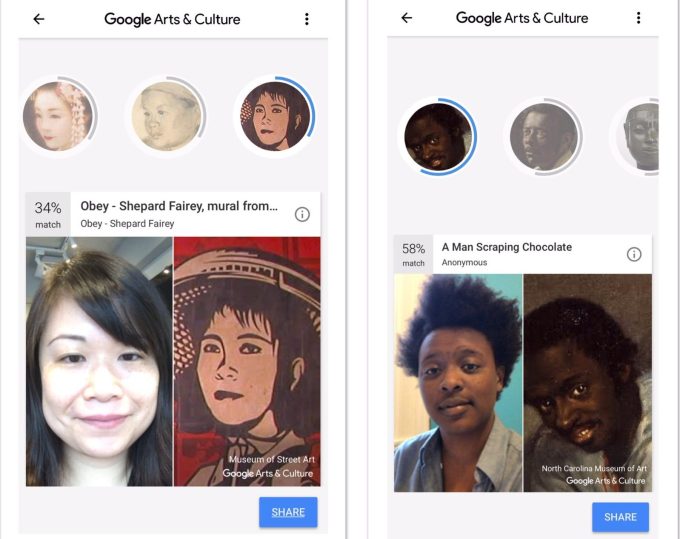
Matches for me and fellow TechCrunch writer Megan Rose Dickey
The selfie characteristic's race trouble did not go unnoticed, prompting social media discussions and gaining coverage in Digg, Mashable, BGR, Hurry, BuzzFeed, Hyperallergic, Marketwatch and KQED Arts, amongst others. (Non surprisingly, the characteristic also raised many privacy concerns. In an interstitial message displayed before the selfie feature, Google tells users that information technology won't use information from selfies for any other purpose than finding an artwork match and won't store photos).
Some might dismiss the give-and-take because Google's art selfies will soon be replaced by the next viral meme. Just memes are the new majuscule of popular culture—and when many people feel marginalized by a meme, and then it demands closer exam.
*usng the @Google Culture and Arts app*
white people: "Wow what beautiful renaissance/impressionist/european painting practise I look like?
me: "Wow what racist stereotype of black people practice I expect similar?"— jimmyNUDEtron (@liluzi_girth) Jan 12, 2018
Who Gets To Decide What Is Art?
Called the Google Art Project when information technology launched in 2011, Google Arts & Civilization was most immediately hit past charges of Eurocentrism. Most of its original 17 partner museums were located in Washington D.C., New York Metropolis or Western Europe, prompting criticism that its scope was besides narrow. Google quickly moved to diversify the project past adding institutions from around the world. Now the program has expanded to a total of 1,500 cultural institutions in 70 countries.
Google Arts & Culture's collections map, nonetheless, shows that American and European collections still boss. Information technology's clear from its posts that the project is making a concerted try to showcase diverse artists, fine art traditions and styles (recent topics included the Raja Ravi Varma Heritage Foundation in Bangalore and Peranakan clothing), but unraveling Eurocentrism means unraveling centuries of bias.
Fifty-fifty now, the management at many American museums doesn't reverberate the country'south demographics. In 2015, the Mellon Foundation released what it said was the first comprehensive survey of diversity in American fine art museums, which was performed with the help of the Association of Art Museum Directors and the American Alliance of Museums. It plant that 84% of direction positions at museums were filled by white people. Minorities were also underrepresented in the junior ranks of museum staff, which means institutions demand to actively nurture young talent if they want their future leaders, including directors and curators, to be various, said the Mellon Foundation.
The art world's diverseness trouble is pushed to the forefront when controversies erupt like the one generated by Dana Schutz'due south painting of Emmett Till's body, which was exhibited at terminal yr'south Whitney Biennal. Many blackness artists were disturbed by how Schutz, who is white, presented Till's body, saying that it both trivalized and exploited racist violence against blackness people. In an interview with NBC News, artist and educator Lisa Whittington blamed the Whitney Biennial leadership'due south homogeneity.
"Their lack of understanding seep onto the walls of the museum, into the minds of viewers and into the society," said Whittington. "In that location should have been more guidance and more thought in the direction of the selections chosen for the Whitney Biennial and there would accept been African American curators and advisors included instead of an all white and all Asian curatorial staff to 'speak' for African Americans."
Progress has been frustratingly irksome. There are now more female than male students in art schools, just exhibitions of gimmicky art are however overwhelmingly dominated by male artists. The turn down in arts education since No Child Left Behind was signed into police force in 2002 has disproportionately afflicted minority students and it was only within the past few years that the College Board reworked the Advanced Placement art history form to address the lack of multifariousness in its syllabus, though about 65% of the artwork used in its form is "still within the Western tradition," according to the Atlantic.
Meanwhile, a report issued last year past the American Alliance of Museums found that non only are museum boards "tipped to white, older males—more than so than at other nonprofit organizations," they accept as well not taken enough action to get more inclusive.
Algorithms Aren't Colorblind
The lack of diverseness reflected in art museums creeps into our definitions of art, culture and ultimately whose experiences matter enough to be preserved. They are reinforced every fourth dimension a person of color walks into a museum and realizes that the few paintings that look like them depict tired stereotypes. While well-intentioned, Google's art selfie characteristic had the same bear upon on many people of color.
Algorithms don't protect united states from our biases. Instead, they absorb, dilate and propagate them, while creating the illusion that technology is sheltered from human prejudices. Facial recognition algorithms have already demonstrated their power to cause damage, such every bit when two black users of Google Photos discovered that it labelled their photos with a "gorilla" tag (Google apologized for the mistake and blocked the image categories "gorilla," "chimp," "chimpanzee" and "monkey" from the app).
Algorithms are merely every bit proficient as their criterion datasets, and those datasets reverberate their creators' biases (conscious or not). This issue is being studied and documented by researchers including MIT graduate student Joy Buolamwini, who founded the Algorithmic Justice League to prevent bias from beingness coded into software, which has unsettling implications for broad-scale racial profiling and civil rights violations. In a TED talk last year, Buolamwini, who is blackness, recounted how some robots with computer vision did a better job of detecting her when she wore a white mask.
"There is an assumption that if you practice well on the benchmarks so you're doing well overall," Buolamwini told The Guardian concluding May. "Just we haven't questioned the representativeness of the benchmarks, so if we exercise well on that criterion we requite ourselves a imitation notion of progress."
The biases making their way into facial recognition algorithms echo the development of color moving-picture show. In the 1950s, Kodak began sending cards depicting female models to photo labs to aid them calibrate skin tones during processing. All of the models were nicknamed Shirley, after the first studio model used, and for decades, all of them were white. This meant that images of black people oft came out over- or nether-developed. In an essay for BuzzFeed, author and lensman Syreeta McFadden described how those photos fed into racist perceptions of black people: "Our teeth and our eyes shimmer through the image, which in its turn get appropriated to imply this is how black people are, mimicked to fit some racialized nightmare that erases our humanity."
Companies similar Google now have an unprecedented opportunity to challenge racism and myopic thinking because their engineering science and the products built on them can transcend the limitations of geography, linguistic communication and civilisation in a style that no other medium has been able to. Google Arts & Culture selfies have the potential to exist more than than a giddy meme, but only if the feature openly acknowledges its limitations–which means against biases in art history, drove and curation more straight and perhaps educating its users about them.
For many people of color, the feature served as yet another reminder of how they have been marginalized and excluded. More than a meme or an app engagement tool, Google's art selfies are an opportunity to look at who gets to define what is culture. Art is i of the ways by which cultures create their collective narratives, and everyone loses out when only a narrow slice of experiences are valued.
websterpoempon1990.blogspot.com
Source: https://techcrunch.com/2018/01/21/why-inclusion-in-the-google-arts-culture-selfie-feature-matters/

Post a Comment for "How Do I Do the Arts and Culture Selfie Thing"