Grace Jones I Did It Again
| Nightclubbing | ||||
|---|---|---|---|---|
 | ||||
| Studio album by Grace Jones | ||||
| Released | eleven May 1981 | |||
| Recorded | 1980–1981 | |||
| Studio | Compass Point, the Bahamas | |||
| Genre |
| |||
| Length | 38:40 | |||
| Label | Island | |||
| Producer |
| |||
| Grace Jones chronology | ||||
| ||||
| Singles from Nightclubbing | ||||
| ||||
Nightclubbing is the 5th studio anthology past Jamaican vocaliser and songwriter Grace Jones, released on xi May 1981 by Island Records. Recorded at Compass Betoken Studios with producers Alex Sadkin and Isle Records' president Chris Blackwell, as well as a team of session musicians rooted past rhythm section Sly and Robbie, the anthology marked her second foray into a new wave style that blends a variety of genres, including reggae, art pop, dub, synth-pop and funk. The album has cover versions of songs past Bill Withers, Iggy Pop, Astor Piazzolla, and others, and original songs, iii of which co-written by Jones.
The album received positive reviews upon its release, including being voted best album of the year by writers of the U.k. music magazine NME, and continues to be praised by critics, with reviewers commending the singer's unique sound and organic fusion of genres. The album entered in the top 10 in five countries, and became Jones' highest-ranking record on the US Billboard mainstream albums and R&B charts. 6 singles were released from the album, including the hits "Pull Up to the Bumper" and "I've Seen That Face Before (Libertango)".
Critics and scholars accept noted the album'due south influence on popular music, especially how its unique sound has been emulated past both popular and alternative acts, and how the persona Jones adopted – securely influenced by art and fashion – has had an enduring influence in modern female person pop singers. Around the time of the album'southward release, she adopted her feature androgynous look which would become popular in fashion. Nightclubbing is now widely considered Jones' all-time studio album[1] and the record that cemented her pop icon status.
Background and production [edit]
"When nosotros were in the studio with Grace, there was a big picture of her – a big picture show, going right across – on the wall of the studio, then she'd be standing in that location singing, and so when nosotros were playing and getting a groove all we could come across was her. Nosotros took it on that reggae kind of trip, but e'er with Grace in heed."
— Drummer Sly Dunbar (of Sly and Robbie), Fact, 2014[ii]
Jones was a popular fashion model and Studio 54 habituée before starting her recording career.[three] Her beginning three albums "were heavily influenced by disco and cemented her presence in the club scene."[4] These records "operated effectually the camper end of the spectrum," and congenital a big gay cult following around the singer.[3] [5] According to Pitchfork, these albums "were fun but somewhat facile, cover-filled reflections of the druggy hedonism of the disco era". T. Cole Rachel writes: "For someone whose very image was seen as somehow deeply transgressive, Jones' music had not all the same defenseless up."[half dozen] When her 1977 rendition of Edith Piaf's "La Vie en rose" was an international hit, she caught the interest of Chris Blackwell, the founder of Isle Records.[iii] Later Jones' 1979 anthology Muse constitute little success in nightclubs and charts, he took over as her producer.[7] He sought to "treat her not every bit a model, but to involve her as a musician", and wanted "her to experience equally though she were a member of a ring, and record her the mode bands used to brand albums, with the vocaliser and the players doing their thing all at in one case."[vii] Blackwell assembled a sextet of studio ringers at his Nassau studio, Compass Indicate, pulling together a band that included Sly and Robbie (consisting of bass guitarist Robbie Shakespeare and drummer Sly Dunbar), French keyboardist Wally Badarou,[8] guitarists Mikey Chung and Barry Reynolds, and percussionist Uziah Thompson. Jones has described the group as "the united nations in the studio".[vi]
As the disco backfire began in earnest, Jones veered towards the contemporary new wave style.[9] Blackwell had been impressed by Blackness Uhuru's 1980 album Sinsemilla and, along with engineer Alex Sadkin, decided that Jones' new sound should take elements from that record'south sonority.[two] Likewise reggae, the band also incorporated trip the light fantastic toe music. Sly Dunbar said, "Nosotros loved dance music, we'd mind to everything, because we were always working and wanting the reggae we did to motility a bit forward, and then annihilation that we could drag to it, we would bring that – as ideas, or as musicians coming to play with us."[2] Ditching the camp quality of Jones' previous work, Blackwell realised new forms around the likes of The Pretenders' "Private Life", Roxy Music's "Love Is the Drug" and The Normal'south "Warm Leatherette"; Ian Wade of The Quietus writes: "Nightclubbing was where all these ideas coalesced into perfection."[3] The band Blackwell assembled later became known as the "Compass Betoken Allstars", taking up residency in the Bahamian studio and animating hits by Tom Tom Gild, Robert Palmer, Joe Cocker and Gwen Guthrie, amongst others.[2] [seven]
The recording sessions "moved with disarming speed and ease"; Blackwell recounts: "If Grace or the grouping hadn't nailed a vocal by the third take, it was dropped and they'd move to the next number." Although the band was initially called upon in early 1980 to work on a unmarried album, they concluded up recording far more material than could fit 1 LP. As a effect, these sessions resulted in ii studio albums: Warm Leatherette – released in 1980 – and Nightclubbing. Final overdubs and additional songs were recorded during 1981. Wally Badarou has recognised Jones' active function in the sessions, stating: "Grace was there even during about instrumental overdubbing sessions. She was a function of the sound and the spirit that came out almost from nowhere. We all knew nosotros were in for something quite experimental."[2]
Composition [edit]
Mode [edit]
Standing the orientation of Jones' previous release Warm Leatherette, Nightclubbing is a pop anthology that forays into new wave[9] [x] [11] and trip the light fantastic,[ii] [12] while in terms of rhythm it is, ostensibly, a reggae record.[13] John Daniel Bull of The Line of Best Fit felt the album "[pinpointed] the peak of [Jones'] Jamaican influences, by fashion of reggae rhythms blended with R&B beats."[14] However, Treble writes: "in terms of atmosphere and melody, there'southward nothing roots or rude-boy well-nigh it."[13] The magazine also considered Nightclubbing to exist an important exponent of sophisti-pop, placing it "somewhere betwixt fine art-pop and dub"; it also described its sonority as "a lush landscape of surrealist synth-popular."[13] The Style Con'south Erich Kessel felt the album was an influential exponent of art-popular.[15] Nightclubbing also incorporates elements of electro, and New York social club music.[2]
A mail-disco album,[xvi] Nightclubbing features a distinct and unprecedented audio that likewise incorporates rock, funk and post-punk music.[9] [ten] The Rolling Stone Album Guide (1992) reads: "Leavening their sprung riddims with a salty dash of funk, Sly and Robbie hipped Jones to stone's new wave on Warm Leatherette and Nightclubbing."[17] According to John Doran of BBC Music, Nightclubbing is a "post-punk popular" anthology that, "delved into the worlds of disco, reggae and funk much more than successfully than almost of her 'culling' contemporaries, while still retaining a blank-eyed alienation that was more than reminiscent of David Bowie or Ian Curtis than nearly of her peers."[eighteen] The influence of David Bowie (Who co-wrote the title rail) was also noted by Joe Muggs of Fact.[2]
The "languid reggae-influenced" tracks allowed Jones to showcase her singular vocal fashion, characterized by low alto singing and a Jamaican way of vocal delivery – "that of 'chatting' over onto tracks" – inside a framework of androgyny.[12] This style of delivery has been likened to that of The Velvet Undercover'southward Lou Reed, Blondie's Debbie Harry, the New York City punk scene, and Gil Scott-Heron in "The Revolution Volition Not Exist Televised".[12] Pitchfork described Jones' voice as a "flat monotone speak-singing."[ix] T. Cole Rachel, writing for the aforementioned publication, argued that Jones succeeds not by the power of her voice, just by the power of her persona, writing: "Equally she would go on to testify in later efforts, it was the monolithic force of her personality—imperious, feral, queer in the truest sense of the word—that would make these songs and then compelling. She is, to put information technology simply, impossible to ignore."[6]
Songs [edit]
The original version of "Libertango" was discovered by Jones'due south boyfriend at the time, artist Jean-Paul Goude, and the video for the song was filmed on the outdoor terrace of Jones's penthouse apartment on 16th Street in New York. The vocal besides features a verse sung in French: the text was translated for Jones by Blackwell's girlfriend, actress Nathalie Delon, for which Delon received a writing credit.[nineteen] Two of the album's tracks, "I've Done It Once more" and "Demolition Homo" were written specifically for Jones to tape on Nightclubbing.[20] The latter song was written by Sting and would too be recorded in a more uptempo style by his band the Police for their album Ghost in the Auto, released half dozen months after Nightclubbing.
The remaining 3 new compositions on the record were all co-written past Jones. "Pull Up to the Bumper" began equally an instrumental track past the Compass Signal Allstars rhythm section Sly and Robbie (credited on the rail under their commonage alias "Koo Koo Baya"), and provisionally called "Pour Yourself Over Me Like Peanut Butter". Jones's friend, singer Dana Mano, came up with the song's new title, which inspired the ii women to write a set up of suggestive lyrics for the rails.[21] Despite this, Jones denied that the lyrics were explicitly sexual, insisting that she felt the words were just written to suit the music, merely stated that she was happy to accept whatever interpretation someone might put on the lyrics, proverb, "I don't want to sing sugariness things, though I don't mind sugariness so long every bit information technology has a piffling sour pregnant underneath". Jones admitted that "Art Groupie" was highly autobiographical as many of her boyfriends had been artists and she was attracted to the whole fine art scene.[22]
Artwork [edit]
Embrace [edit]
Nightclubbing 's iconic artwork is a 1981 painted photograph titled Blueish-Black in Black on Brown, created in New York past Goude.[23] This was the atypical paradigm that accompanied the original LP, every bit information technology "was concealed in a plain, black inner sleeve, no lyrics and with no photo on the back cover."[24] Equanimous by right angles, the photo shows Jones cut to waist, bare chested, and dressed in an Armani homo'southward broad shouldered suit, with an unlit cigarette aiming downward from her lip. She is shot with her signature flat top haircut and her breast bones showing; her dark skin confers upon the image a violet, blue-black color.[12] [24] [25] The prototype is noted for its androgyny, with Jones non only "[unpicking] some of the boundaries of unconventionality, only [choosing] to confuse such boundaries."[12] Rick Poynor writes: "Goude admired Jones for her mixture of beauty and threat, and the Nightclubbing portrait expresses this duality with absolute sophistication and no faux histrionics."[26] Piers Martin of Uncut felt the comprehend was "absorbing", and wrote: "the indigo mood, cool gaze and cigarette suggested Marlene Dietrich, the gender-bending a bear on of Bowie."[ten]
In 2015, Dazed included the album comprehend in an commodity dedicated to their "favourite Armani cult crossovers." Biju Belinky wrote:
Although Armani became known for deconstructing the suit, removing the over-the-tiptop padding and offering a relaxed pick to formalwear in American Gigolo, the embrace for Grace Jones' iconic 1981 album Nightclubbing plays upwards with the angles similar nothing else before it. Hailed as a pioneer of the androgynous await, with a cigarette dangling from her mouth and a flattop haircut, complemented past the padded shoulders of an Armani jacket, the avant-garde singer's anthology cover became known for years to come.[27]
Writing for DIY, Simon Russell Beale listed the anthology encompass as one of the greatest of all time, highlighting Jones' "smouldering noir-bisexuality".[28] Graphic designer Storm Thorgerson included the moving picture in his 1999 book, 100 Best Anthology Covers.[29] Moreover, American Photo placed it in its list of The 30 Best Album Covers.[30] NME included it in its list of 20 Original Album Covers That Are Actually Works of Art, with the entry reading: "Can any other artist boast as many iconic album covers? Grace is a work of fine art herself, as are the covers for Island Life, Slave to the Rhythm and Living My Life, simply best of all is the louche image of Nightclubbing by Jean-Paul Goude, role Tretchikoff'due south Green Lady, role the best advertizement for smoking you've ever seen."[31] Time Out listed the image equally 1 of the "sexiest album covers of all time", with Brent DiCrescenzo writing: "[Grace Jones] was a work of fine art, a statue."[32] According to i-D, "it was a series of consistently stellar anthology artwork that helped propel [the singer] from musician to icon."[33] The artwork was held in display at the Padiglione d'Arte Contemporanea in Milan, Italian republic, as part of the 2016 And then Far So Goude exhibition, focused on the French artist.[34]
Video [edit]
Co-ordinate to Barry Waters of The Pitchfork Review, "Jones' singular appearance and meticulously crafted presentation made her a natural fit for the burgeoning music video medium, especially in its early, experimental days."[vii] Jean-Paul Goude directed the music videos for "I've Seen That Face up Earlier (Libertango)" and "Pull Up to the Bumper", besides as the historic 1982 VHS release A One Human Show. The latter – a montage of yet photography, concert footage and music videos – "asserted [Jones] as an astute visual creative person" and was nominated for Best Long Form Music Video at the 26th Annual Grammy Awards.[7] [35] Nelson George, reviewing the release for Billboard in early 1983, called it "one of the more fascinating and defiantly visual concert videos yet produced."[36] According to Ernest Hardy of CraveOnline, the film "seamlessly blends cabaret, performance fine art and underground nightclub cool."[37]
Release [edit]
Nightclubbing became Jones' nautical chart breakthrough and remains one of the greatest commercial triumphs of her entire career. It entered the top five in no less than 4 countries, and became the singer'south highest-charting record on the US Billboard mainstream albums and R&B charts. The anthology brought Jones from being a onetime disco diva with a loyal cult post-obit but dropping sales figures to an international star with mainstream nautical chart success. It later formed the ground of her groundbreaking concept bout A One Man Testify.
Universal Music Group re-released the anthology on vinyl in 2009.[38]
Release of a two-disc palatial set, containing most of the 12" single versions of singles, plus 2 unreleased tracks from the Nightclubbing sessions, occurred on 28 Apr 2014, and Jones enjoyed a UK top 50 nautical chart placing the following week – her start since 2008.
To promote the anthology, Jones appeared on diverse Television set shows in 1981, including the French Palmarès,[39] the Spanish Esta noche, [40] and Aktuelle Schaubude in Westward Federal republic of germany.[41]
Singles [edit]
The lead unmarried from the album was "Demolition Man". The single was not a commercial success and did not chart, although would afterward go i of Jones' signature songs. "I've Seen That Face Before (Libertango)" was released as the second unmarried and became 1 of the nigh commercially successful songs in Jones' repertoire. Information technology secured tiptop 20 positions in several European countries and became another signature song for Jones.
The R&B-dance rails "Pull Up to the Bumper" was a quick follow-up to "Libertango". Information technology met with a smashing success on the US club market, merely turned out a modest hit in Europe upon original release. The vocal would re-sally in Europe in 1985 as a major success, especially in the UK, where backed with "La Vie en rose" it became 1 of Jones' highest-charting singles in that country.
"Use Me" and "Feel Up" were then released as singles, but were unsuccessful in the charts. The final single off Nightclubbing, "Walking in the Rain", was a minor chart success.
Disquisitional reception [edit]
| Review scores | |
|---|---|
| Source | Rating |
| AllMusic |   [8] [8] |
| Christgau'southward Record Guide | B−[42] |
| Mojo | [43] |
| Pitchfork | ix.0/10[nine] |
| Q |  [44] [44] |
| Tape Collector | [v] |
| Tape Mirror | [45] |
| The Rolling Rock Album Guide | [17] |
| Blast Hits | 8/ten[46] |
| Uncut | ix/10[10] |
In the UK Adrian Thrills of NME said, "I spent an otherwise-miserable weekend afternoon with the sound of Grace swirling around my little earphones, grooving on songs effortlessly sung simply put together with a jeweller'southward eye for detail", and stated that the musicians "combine to etch out a shifting, soulful surface, an exotic ice-water backdrop for Grace's vocal veneer", noting that "the only times Grace seems ill-at-ease are as she swops Trenchtown patois with, presumably, the precipitous-lipped Sly and and then tries to rock out on Sting's 'Demolition Man'".[20] Roz Reines of Tune Maker chosen it "an album with something for anybody: reggae, electronics, disco, blues – even a snatch of salsa funk. The incredible thing is that it all gels together so well – the common denominator is the danceability, which lasts all the manner through: changes in tempo and footstep only help to sustain the energy level."[47] Deanne Pearson of Smash Hits said that Jones' vox has "neither range nor power", only "the arrangements and product about brand upward for this."[46] Record Mirror critic Simon Ludgate establish that Jones transcends her vocal limitations through "her grapheme and sense of the surreal".[45]
Andy Kellman of AllMusic praised the album in a retrospective review, stating: "Sly & Robbie provide ideal backdrops for Jones yet again, casting a brisk but not bristly sheen over buoyant structures. Never before and never since has a precisely chipped block of ore been so seductive."[8] Mark Coleman wrote in The Rolling Stone Anthology Guide that Sly and Robbie's introduction of new wave rock to Jones and the "throbbing polyrhythmic" covers of rock songs suited her better than the Edith Piaf-meets-Barry White routines" of her records.[17] Robert Christgau was less enthusiastic. He was unmoved past Jones' own songs and said while the covers on Warm Leatherette were superior to the originals simply because of her "weird force of personality", she could not match "Use Me" and the title rail.[42]
Nightclubbing continued to gather favorable reviews with the release of the deluxe edition in 2014. Andy Beta from Pitchfork labeled the album's reissue equally "Best New Reissue", describing the album every bit "the record that further cemented her iconic condition in pop civilisation". He also stated: "She treats each cover not equally a singer tackling a song, just as an actor inhabiting the skin of a role".[9] Mojo called information technology "probably the greatest of Grace Jones' Compass Point trio".[43] Uncut 'due south Piers Martin chosen Nightclubbing "the album that came to define Jones as the consummate performer, in her own fashion, every bit singer, muse, actress, alien and androgyne. Its sound, a sublime mix of reggae, funk, new wave and disco, was equally arresting every bit its comprehend epitome... No one had seen or heard annihilation quite like this".[ten] In Record Collector Kris Needs said that "Nightclubbing still sounds like goose egg else released during the 80s, though its colossal influence repeatedly reveals itself".[5] John Harris of Q wrote that "the music on Nightclubbing is as stripped-down and total of space every bit Jones's froideur demanded. Then again, when it evokes more emotional qualities, it also triumphs."[44]
Legacy [edit]
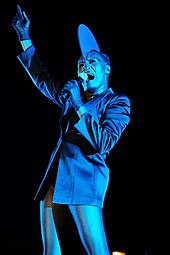
Nightclubbing 's distinctive amalgamation of rock, funk, mail-punk, popular and reggae set Jones apart from other musical acts of the 1980s. Information technology is considered one of the early convergences of "fashion, art, and music".[xv] According to Pitchfork 's Andy Beta, information technology "altered the face of modern pop". He farther argued that the anthology's musical and visual influence is easily palpable in the musical landscape of the 21st century, particularly amid female musicians such as Lady Gaga, Rihanna, Nicki Minaj, M.I.A., Grimes and FKA Twigs, amongst others.[9] Other acts influenced by the tape include Róisín Murphy, Janelle Monáe, Azealia Banks and Adam Lambert.[15] Across pop music, the template gear up past Jones and her Compass Betoken bankroll band was also influential to alternative music, including Massive Assail, Todd Terje, Gorillaz, Hot Chip, and LCD Soundsystem – who "emulate those rubbery yet taut grooves of Sly & Robbie and cohorts".[9] In Q, John Harris wrote: "The fact that this music was starting time released 33 years ago beggars belief: it showcases corking minds alighting on the future, and points the manner to Madonna, Björk, Lady Gaga, Gorillaz, Grand.I.A. and more."[44] According to Molly Beauchemin, Jones "pioneered the way for Shamir, Stromae, and countless other trip the light fantastic mavericks of today – not just with her bewitching artlessness but through her use of androgynous innuendo".[vii] Polari Magazine considered Nightclubbing to be "a defining moment in the history of pop music".[24]
The album further cemented Jones' pop icon condition.[nine] According to Erich Kessel, "[the vocalist'southward] performances were a source of rich critiques on race, gender, and blackness."[15] Her pioneering androgynous aesthetic – conceived alongside Jean-Paul Goude – had a strong touch on the pop culture of the 1980s; for case, information technology was a precursor to Annie Lennox's persona.[nine] [12] According to Abigail Gardner, "Jones was an androgynous audiovisual experience, one who sat comfortably within the context of early 1980s pop, where image had get even more primal to pop operation through the emergence of MTV."[12] She further argued that the singer "problematises ideas of black feminine in performance fine art that contributed to a reconceptualisation of Afrocentric culture and identity."[48] Miriam Kershaw positioned Jones "not as a singer or a diva, but as a slice of art", and argued that she "worked to destabilise racist and sexist clichés as she charted a dynamic class through the history of the Blackness diaspora, to gloat its vibrant contemporary class."[48] The singer's gender-bending and unrestrained sexuality also won the acclamation of the gay community,[7] [18] existence included in Out 's "The 100 Greatest, Gayest Albums of All Fourth dimension" and Attitude 'south "Tiptop 50 Gay Albums of All Time".[49] i-D writes: "Jones transcended definition in almost every realm of her life. She is often referred to as a queer icon. [...] She rejects all labels of sexuality, and her musical output is similarly fluid, switching from pop and disco to dub and reggae without hesitation."[33]
In The Village Vox 'due south Pazz & Jop critics' poll of 1981, Nightclubbing placed at number 31, while "Pull Up to the Bumper" was voted the year'due south 11th best unmarried.[l] Information technology also appeared in the year-end lists of Sounds,[51] Rockerilla, OOR, The Confront, Melody Maker and NME – the latter considering it the best anthology of 1981.[49] [52] Slant Magazine listed Nightclubbing every bit the 40th best album of the 1980s, with Henderson writing it "performs double duty, building up the singer's legend fifty-fifty as it makes attempts at deconstructing it."[53] NME included the anthology in its listing of The 500 Greatest Albums of All Time, with its entry stating: "A glimpse into the sordid disco depravities behind the velvet rope at Studio 54, Nightclubbing and its standout nail "Pull Upward to the Bumper" shunted new wave, reggae and disco firmly into the seductive neon '80s with a single arse/car metaphor."[54] The Guardian listed Nightclubbing every bit ane of the "1000 albums to hear before you dice".[55]
Accolades [edit]
The information regarding lists including Nightclubbing is adapted from Acclaimed Music, except where otherwise noted.[49]
| Publication | State | Accolade | Year | Rank | ||
|---|---|---|---|---|---|---|
| Studio Brussels | Belgium | The 500 Greatest Albums of All Time, Nominations | 2015 | * | ||
| Christophe Brault | France | Superlative xx Albums by Year 1964–2004 | 2006 | ix | ||
| Gilles Verlant | 300+ Best Albums in the History of Stone | 2013 | * | |||
| Rock & Folk | The 250 All-time Albums from 1966 to 1991 | 1991 | * | |||
| Laut | Germany | Milestones | — | * | ||
| Musik Express/Sounds | The 50 All-time Albums from the 80s | 2003 | 24 | |||
| RoRoRo Rock-Lexicon | Virtually Recommended Albums | 2003 | * | |||
| Tempo | The 100 All-time Albums from the eighty'southward | 1989 | 17 | |||
| Giannis Petridis | Hellenic republic | 2004 of the All-time Albums of the Century | 2003 | * | ||
| Hot Press | Ireland | The 100 All-time Albums of All Time | 1989 | 59 | ||
| Rockerilla | Italian republic | Albums of the Twelvemonth | 1981 | xiii | ||
| OOR | Netherlands | 12 | ||||
| Adresseavisen | Norway | The 100 (+23) Best Albums of All Time | 1995 | 87 | ||
| Eggen & Kartvedt | The Guide to the 100 Of import Rock Albums | 1999 | * | |||
| Panorama | The xxx Best Albums of the Year 1970–98 | 1999 | 15 | |||
| Attitude | Uk | Top 50 Gay Albums of All Time | — | 14 | ||
| The Face | Albums of the Year | 1981 | * | |||
| GQ | The 100 Coolest Albums in the Globe Right At present! | 2005 | vii | |||
| The Guardian | 1000 Albums to Hear Earlier You Die | 2007 | * | |||
| Melody Maker | Albums of the Year | 1981 | nine | |||
| Mojo | The 80 Greatest Albums from the 80s | 2007 | * | |||
| Gary Mulholland | 261 Greatest Albums Since Punk and Disco | 2006 | * | |||
| Muzik | Peak 50 Dance Albums of All Fourth dimension | 2002 | 34 | |||
| NME | Albums of the Year | 1981 | 1 | |||
| The 500 Greatest Albums of All Time | 2013 | 211 | ||||
| Out | United states | The 100 Greatest, Gayest Albums | 2008 | 91 | ||
| Slant Magazine | The 100 All-time Albums of the 1980s | 2012 | 40 | |||
| Sounds | Albums of the Year[51] | 1981 | * | |||
| The Village Vocalism | Pazz & Jop | 1981 | 31 | |||
| (*) designates lists that are unordered. | ||||||
Track listing [edit]
| No. | Title | Writer(s) | Length |
|---|---|---|---|
| i. | "Walking in the Pelting" | Harry Vanda, George Young | 4:xviii |
| 2. | "Pull Upward to the Bumper" | Grace Jones, Koo Koo Baya, Dana Mano | iv:41 |
| 3. | "Use Me" | Beak Withers | v:04 |
| 4. | "Nightclubbing" | David Bowie, Iggy Pop | 5:06 |
| No. | Title | Writer(s) | Length |
|---|---|---|---|
| 5. | "Fine art Groupie" | Jones, Barry Reynolds | 2:39 |
| half dozen. | "I've Seen That Face Earlier (Libertango)" | Ástor Piazzolla, Reynolds, Dennis Wilkey, Nathalie Delon | 4:xxx |
| 7. | "Feel Upwardly" | Jones | four:03 |
| 8. | "Demolition Man" | Sting | four:03 |
| nine. | "I've Done It Once more" | Reynolds, Marianne Faithfull | 3:51 |
| No. | Title | Writer(s) | Length |
|---|---|---|---|
| 1. | "Demolition Man" (12" version) | Sting | 4:58 |
| 2. | "Pull Upwardly to the Bumper" (12" version) | Grace Jones, Koo Koo Baya, Dana Mano | v:45 |
| 3. | "I've Seen That Face Before (Libertango)" (12" version) | Astor Piazzolla, Barry Reynolds, Dennis Wilkey, Nathalie Delon | five:38 |
| 4. | "Walking in the Rain" (12" version) | Harry Vanda, George Young | 7:25 |
| 5. | "Pull Up to the Bumper" (remixed version) | Grace Jones, Koo Koo Baya, Dana Mano | 7:fifteen |
| 6. | "Use Me" (long version) | Nib Withers | 6:10 |
| seven. | "Pull Up to the Bumper" (United states of america party version) | Grace Jones, Koo Koo Baya, Dana Mano | 5:00 |
| 8. | "Experience Upwards" (extended version) | Grace Jones | vi:xv |
| 9. | "Pull Upwardly to the Bumper" (1985 remix) | Grace Jones, Koo Koo Baya, Dana Mano | 6:24 |
| 10. | "Peanut Butter" (Performed past Compass Indicate All-Stars) | Grace Jones, Koo Koo Baya, Dana Mano | five:10 |
| 11. | "If You lot Wanna Be My Lover" (Previously unreleased) | 6:35 | |
| 12. | "Me! I Disconnect from You" (Previously unreleased) | Gary Numan | v:33 |
| thirteen. | "Esta Cara Me es Conocida" (Spanish version of "I've Seen That Face Before (Libertango)") | Astor Piazzolla, Barry Reynolds, Dennis Wilkey, Nathalie Delon | 4:32 |
- The ii-disc palatial remastered version states that the writer(southward) of "If Y'all Wanna Be My Lover" is unknown.
Personnel [edit]
Credits adapted from Nightclubbing'southward liner notes.[56]
Charts [edit]
Weekly charts [edit]
| Year-finish charts [edit]
|
Certifications [edit]
Release history [edit]
| Region | Date | Format(south) | Label |
|---|---|---|---|
| Worldwide | 11 May 1981 | LP, Cassette | Island |
| Yugoslavia | Jugoton | ||
| Europe | 1989 | CD | Isle Masters |
| Worldwide | 1990 | Island | |
| 28 April 2014 | ii-CD deluxe edition, Blu-ray sound |
See also [edit]
- 1980s in music
- Music of the United Kingdom (1980s)
- Music of Jamaica
- 1980s in Western fashion
- Media studies
- Reggae fusion
- Gay icon
References [edit]
- ^ "3333. "Walking In The Pelting" by Grace Jones". sadclownrep.com. Archived from the original on 21 February 2014. Retrieved 19 Baronial 2012.
- ^ a b c d e f g h Muggs, Joe (two May 2014). "I've Seen That Confront Earlier: looking dorsum on Grace Jones' iconic Nightclubbing with the people who made it happen". Fact . Retrieved xxx July 2016.
- ^ a b c d Wade, Ian (12 May 2014). "Grace Jones – Nightclubbing (Reissue)". The Quietus . Retrieved thirty July 2016.
- ^ Nelson, Terry (9 May 2016). "TRIBUTE: Jubilant 35 Years of Grace Jones' 'Nightclubbing'". Albumism. Retrieved thirty July 2016.
- ^ a b c Needs, Kris (June 2014). "Grace Jones – Nightclubbing: Deluxe Edition". Record Collector. No. 428. London. pp. 90–91. Retrieved 5 February 2018.
- ^ a b c Rachel, T. Cole (26 June 2016). "Grace Jones: Warm Leatherette". Pitchfork . Retrieved eighteen Baronial 2016.
- ^ a b c d e f g h Waters, Barry (25 August 2015). "As Much As I Tin, Equally Black As I Am: The Queer History of Grace Jones". The Pitchfork Review . Retrieved 30 July 2016.
- ^ a b c Kellman, Andy. "Nightclubbing – Grace Jones". AllMusic. Retrieved i May 2014.
- ^ a b c d due east f 1000 h i j Beta, Andy (1 May 2014). "Grace Jones: Nightclubbing". Pitchfork . Retrieved 1 May 2014.
- ^ a b c d east Martin, Piers (June 2014). "Grace Jones – Nightclubbing (Deluxe Edition)". Uncut. No. 205. London. p. ninety. Archived from the original on 14 July 2014. Retrieved 9 June 2014.
- ^ Robbins, Ira A., ed. (June 1983). The Trouser Press Guide to New Wave Records. Charles Scribner'south Sons. p. 156. ISBN978-0684179445.
- ^ a b c d eastward f yard Gardner, 2012. p.87
- ^ a b c Terich, Jeff; Blyweiss, Adam; Bossenger, A.T.; Prickett, Sam (24 April 2014). "10 Essential Sophisti-pop albums". Treble. Retrieved 7 Baronial 2016.
- ^ Bull, John Daniel (29 April 2014). "Grace Jones – Nightclubbing [Deluxe Edition]". The Line of Best Fit . Retrieved 4 August 2016.
- ^ a b c d Kessel, Eric (viii May 2014). "Art-Pop before 'Art Pop" . The Style Con. Archived from the original on i Jan 2018. Retrieved 5 August 2016.
- ^ Vine, Richard (15 June 2011). "Grace Jones pulls up to the bumper". theguardian.com . Retrieved thirty August 2016.
- ^ a b c Coleman, Marker (1992). "Grace Jones". In DeCurtis, Anthony; Henke, James; George-Warren, Holly (eds.). The Rolling Rock Album Guide (3rd ed.). Random House. pp. 378–79. ISBN0679737294.
- ^ a b Doran, John (2010). "Grace Clubbing – Nightclubbing review". BBC. Retrieved 3 August 2016.
- ^ Jones, Grace; Morley, Paul (2015). I'll Never Write My Memoirs. New York, USA: Simon & Schuster. pp. 215–17. ISBN978-1-47113-521-vii.
- ^ a b Thrills, Adrian (2 May 1981). "Grace Jones: Nightclubbing". NME. London. p. 33.
- ^ Jones; Morley (2015). p. 226.
- ^ Salewicz, Chris (25 July 1981). "In Betwixt the Bumpers". NME. pp. 48–49.
- ^ Vocal, Sandra (5 October 2015). "Welcome to Planet Grace Jones". Newspaper . Retrieved iv August 2016.
- ^ a b c "Grace Jones' Nightclubbing: A Celebration". Polari Magazine. Retrieved 4 August 2016.
- ^ Walters, Barry (4 April 2014). "'Nightclubbing' Again: Revisiting Grace Jones'due south Masterpiece". Wondering Sound. Archived from the original on 19 August 2016. Retrieved 5 August 2016.
- ^ Poynor, Rick (15 September 2015). "Exposure: Grace Jones by Jean-Paul Goude". Pattern Observer. Retrieved 5 August 2016.
- ^ Belinky, Biju (2015). "Charting Armani's cult crossovers". Dazed . Retrieved five Baronial 2016.
- ^ Tesco, Lucy (19 Oct 2010). "Top 5 Anthology Covers: Rough Trade". DIY . Retrieved 5 Baronial 2016.
- ^ Thorgerson, Storm (23 September 1999). 100 All-time Album Covers. DK. ISBN978-0751307061.
- ^ Crager, Jack (November 2008). "The 30 All-time Album Covers". American Photo. Vol. nineteen, no. six. p. 30. ISSN 1046-8986. Retrieved 5 Baronial 2016.
- ^ "20 Original Anthology Covers That Are Actually Works of Art". NME. v March 2015. Retrieved five August 2016.
- ^ DiCrescenzo, Brent (28 May 2014). "The 45 sexiest album covers of all time". Time Out . Retrieved 5 August 2016.
- ^ a b Hall, Jake (21 April 2016). "exploring the complicated relationship between jean-paul goude and grace jones". i-D . Retrieved 8 Baronial 2016.
- ^ Stansfield, Ted (2016). "Inside Jean-Paul Goude'southward new exhibition". Dazed . Retrieved 5 August 2016.
- ^ Anderson, Melissa (February two, 2016). "Grace and Beloved: 'A 1 Man Show' Brings Dorsum '82, and Wendy Clarke Asks the Big Questions". The Village Voice. The Hamlet Voice LLC. Retrieved November 20, 2016.
- ^ George, Nelson (Feb 12, 1983). "Video Reviews". Billboard. Vol. 95, no. 5. p. 31. ISSN 0006-2510. Retrieved Nov twenty, 2016.
- ^ Hardy, Ernest (February 12, 2016). "Grace Jones' Classic 'One Man Evidence' Screens Tonight in LA". CraveOnline. Retrieved November 28, 2016.
- ^ "Grace Jones – Nightclubbing (Vinyl, LP, Album) at Discogs". www.discogs.com. Retrieved 28 May 2012.
- ^ Palmarès (in French). 29 April 1981.
- ^ Esta Noche (in Spanish). Televisión Española. 2 July 1981.
- ^ Aktuelle Schaubude (in German language). Norddeutscher Rundfunk. 26 September 1981.
- ^ a b Christgau, Robert (1990). "Grace Jones: Nightclubbing". Christgau'due south Record Guide: The '80s. Pantheon Books. p. 219. ISBN067973015X . Retrieved 1 May 2014.
- ^ a b Wood, Anna (June 2014). "Grace Jones: Nightclubbing". Mojo. No. 247. London. p. 106.
- ^ a b c Harris, John (June 2014). "Grace Jones: Nightclubbing (Deluxe Edition)". Q. No. 335. London. p. 124.
- ^ a b Ludgate, Simon (16 May 1981). "Grace and Danger". Record Mirror. London. p. 23.
- ^ a b Pearson, Deanne (28 May – 10 June 1981). "Grace Jones: Nightclubbing". Nail Hits. Vol. 3, no. 11. London. p. 23B.
- ^ Reines, Roz (23 May 1981). "Grace Jones: Nightclubbing". Tune Maker. London. p. 25.
- ^ a b Gardner, 2012. p.89
- ^ a b c "Nightclubbing – Grace Jones". Acclaimed Music. Retrieved 5 August 2016.
- ^ Anon. (1 February 1982). "The 1981 Pazz & Jop Critics Poll". The Village Voice . Retrieved 31 May 2016.
- ^ a b "Best Albums of 1981". Sounds. London. nineteen December 1981.
- ^ "Vinyl Finals". NME. xix December 1981. p. xxx.
- ^ Henderson (2012). "The 100 Best Albums of the 1980s". Slant Magazine . Retrieved v August 2016.
- ^ "The 500 Greatest Albums Of All Fourth dimension: 300-twenty". NME. 2013. Retrieved five August 2016.
- ^ "1000 albums to hear before yous die: Artists beginning with J". guardian.com. 20 November 2007. Retrieved 5 August 2016.
- ^ Nightclubbing (LP record). Grace Jones. Island Records. 1981. ILPS 9624.
{{cite AV media notes}}: CS1 maint: others in cite AV media (notes) (link) - ^ Kent, David (1993). Australian Chart Volume 1970–1992 (illustrated ed.). St Ives, N.S.W.: Australian Nautical chart Volume. p. 160. ISBN0-646-11917-vi.
- ^ "Dutchcharts.nl – Grace Jones – Nightclubbing" (in Dutch). Hung Medien.
- ^ "Offiziellecharts.de – Grace Jones – Nightclubbing" (in German). GfK Entertainment Charts. Retrieved 26 February 2018.
- ^ "Charts.nz – Grace Jones – Nightclubbing". Hung Medien.
- ^ "Norwegiancharts.com – Grace Jones – Nightclubbing". Hung Medien.
- ^ Salaverrie, Fernando (September 2005). Sólo éxitos: año a año, 1959–2002 (in Spanish) (1st ed.). Madrid: Fundación Autor/SGAE. ISBN84-8048-639-two.
- ^ "Swedishcharts.com – Grace Jones – Nightclubbing". Hung Medien.
- ^ "Official Albums Nautical chart Top 100". Official Charts Company. Retrieved 26 February 2018.
- ^ "Grace Jones Chart History (Billboard 200)". Billboard. Retrieved 26 February 2018.
- ^ "Grace Jones Nautical chart History (Top R&B/Hip-Hop Albums)". Billboard. Retrieved 24 December 2021.
- ^ "Ultratop.be – Grace Jones – Nightclubbing" (in Dutch). Hung Medien. Retrieved 24 Dec 2021.
- ^ "Ultratop.be – Grace Jones – Nightclubbing" (in French). Hung Medien. Retrieved 24 December 2021.
- ^ "Official Albums Chart Meridian 100". Official Charts Company. Retrieved 26 February 2018.
- ^ Kent 1993, p. 433
- ^ "Jaaroverzichten – Anthology 1981" (in Dutch). Dutch Charts. Retrieved 24 Dec 2021.
- ^ "Meridian 100 Album-Jahrescharts – 1981" (in German language). Offizielle Deutsche Charts. Retrieved 24 December 2021.
- ^ "Pinnacle Selling Albums of 1981". Recorded Music NZ. Retrieved 24 December 2021.
- ^ "Height Selling Albums of 1982 — The Official New Zealand Music Chart". Recorded Music New Zealand. Retrieved i February 2022.
- ^ "Top Selling Albums of 1983 — The Official New Zealand Music Chart". Recorded Music New Zealand. Retrieved 2 February 2022.
- ^ "ARIA Charts – Accreditations – 1997 Albums" (PDF). Australian Recording Industry Association.
- ^ "Gold-/Platin-Datenbank (Grace Jones;'Night Clubbing')" (in German). Bundesverband Musikindustrie.
- ^ "New Zealand anthology certifications – Grace Jones – Nightclubbing". Recorded Music NZ.
Bibliography [edit]
- Gardner, Abigail (4 October 2012). "Framing Grace: Shock and Awe at the Ageless Blackness Body". 'Stone On': Women, Ageing and Popular Music. Routledge. ISBN978-1409428411.
External links [edit]
- Nightclubbing at Discogs (list of releases)
- Nightclubbing statistics, tagging and previews at Concluding.fm
- Nightclubbing at Rate Your Music
- Jean-Paul Goude, official website
websterpoempon1990.blogspot.com
Source: https://en.wikipedia.org/wiki/Nightclubbing_%28Grace_Jones_album%29

Post a Comment for "Grace Jones I Did It Again"